Phonetics & Soundscape – The Gentle Song of Words
Characteristic Sounds
Flowing consonants such as “L”, “V”, “R”, “Th”, “S”, “M” and “N” shape the sound of the language.
Harsh sounds such as “K” or “G” are rare and are spoken softly when they occur.
Long, resonant vowels such as “Aê”, “Éa”, “Ith” and “Uén” give the language its melodic character.
Double vowels or gentle consonants emphasize intensity and beauty:
“Eláe” — “light”
→ “Eláëa” — “radiant light that echoes among the stars.”
Words glide into one another without abrupt pauses or harsh breaks.
Sound Examples
“Ilétharin” — “The Language of Light”, the name of the High Elven tongue.
“Valaëth” — “The Voice of the Forest.”
“Sélarin” — “The Shimmering Sky.”
“Líthara” — “The Eternity of the River.”
“Sánaë” — “Gentle as the first light of morning.”
“Éthalivor” — “Wisdom that flows through time.”
Grammar & Sentence Structure – A Language as Fluid as Water
Ilétharin follows a harmonious, artful grammar that adapts to the flow of speech without becoming rigid or angular.
Sentence Structure
The natural word order follows Subject – Verb – Object.
“Élen valarëa líthara.”
→ “The water of the river flows eternally.”
Adjectives usually follow the noun in order to preserve the flow of the language.
“Elanár sélarin.”
→ “The light of the sky.”
When adjectives are placed before the noun, they create heightened emotional force or reverence.
“Sélarin Elanár.”
→ “A heavenly light of particular purity.”
Tenses
The past is marked with “é-” or “l’”.
“L’valarëa.”
→ “It once flowed.”
The present remains unchanged.
“Valarëa.”
→ “It flows.”
The future is introduced with “tha-” or “an-”.
“Tha’valarëa.”
→ “It will flow.”
Plural Formation
Words ending in vowels form the plural with “-éa” or “-thir”.
“Líthara” — “river”
→ “Lítharéa” — “rivers.”
Words ending in consonants form the plural with “-in” or “-iel”.
“Sélarin” — “sky”
→ “Sélariel” — “heavenly expanses.”
Cases & Prepositions
Ilétharin avoids harsh case endings and instead uses soft prepositions or blended word forms:
“en”
→ belonging or possession.
“Léa en valaëth.”
→ “The song of the forest.”
“va”
→ direction or relation.
“Éthan va Lenea.”
→ “I travel to Lenea.”
“aë”
→ purpose or dedication.
“Aluën aë thiel.”
→ “A gift for you.”
Phrases & Terms – Words That Move Like Water
Typical Terms
“Ilétharin” — The Language of Light.
“Valaëth” — The Voice of the Forest.
“Sélarin” — The Shimmering Sky.
“Líthara” — River / Time.
“Éthalivor” — Wisdom / Eternity.
“Sánaë” — Gentleness / Light of Dawn.
Typical Phrases
“Valaëth en Ilétharin.”
→ “The voice of the forest speaks in our language.”
“Líthara sélariel tha’veniëa.”
→ “The streams of the heavens shall flow on forever.”
“Aluën aë thiel, énaë líthara.”
→ “A gift for you; may it flow like the river.”
“Éthalivor éthariëan l’enariel.”
→ “Wisdom shines like the stars in the night.”
Gesture & Body Language – The Silent Poetry of the High Elves
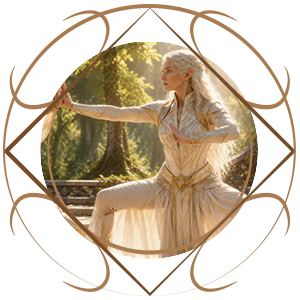
Ilétharin is not only a spoken language. It lives through subtle, meaningful gestures that accompany the words.
Typical Gestures
A gently raised palm
→ A sign of greeting or agreement.
A fingertip placed upon the heart
→ An expression of respect or gratitude.
A lightly inclined head
→ A sign of listening or deep reflection.
An open hand with slightly curved fingers
→ A symbol of invitation or sharing.
Script & Symbolism – A Dance of Light and Signs
Features of the Script
Soft, curved lines reminiscent of flowing water.
Connected letters, as though they were dancing with one another.
Important words are often written in silver or golden ink.
Poetry and sacred texts are adorned with delicate illustrations.
The Language That Whispers and Sings
Ilétharin is marked by gentle, melodic pronunciation and harmonious sounds.
Its sentence structure preserves beauty and flow.
Its script moves like water.
It is a language of wisdom, diplomacy and poetry.
Ilétharin is more than words. It is the echo of nature, the whisper of the forest, the song of time.
Dictionary of the High Elves of Hylundér
| Word (Ilétharin) |
Translation |
Meaning |
| Ilétharin |
Language of Light |
Name of the High Elven language. |
| Valaëth |
Voice of the Forest |
A metaphor for the ancient wisdom of nature. |
| Sélarin |
The Shimmering Sky |
A poetic expression for the night sky. |
| Líthara |
River / Time |
Refers to the flow of time or the waters of the world. |
| Éthalivor |
Eternal Wisdom |
A deep form of understanding and knowledge. |
| Sánaë |
The Gentle Light of Morning |
A symbol of new beginnings and harmony. |
| Eláëa |
Radiant Light |
Refers to divine or exalted beauty. |
| Éthariel |
Voice of the Stars |
Used for prophets or wise advisers. |
| Valandor |
Guardian of the Forest |
An honorific title for guardians of nature. |
| Sylveris |
Whisper of Leaves |
Used for subtle or secret messages. |
| Ithariel |
Song of Night |
A poetic expression for elven music. |
| Sarethil |
Gleam of the Winds |
An expression of speed and grace. |
| Elandor |
The Wanderer |
A title for a traveler or seeker of knowledge. |
| Vaeriel |
Golden Leaves |
An expression of autumnal beauty or transience. |
| Thalien |
The Observer |
Refers to a calm, far-seeing thinker. |
| Quenaris |
Flame of Wisdom |
An honorific title for scholars or mages. |
| Ilthara |
The Hidden One |
Used for spies or keepers of knowledge. |
| Lairiel |
Whispering Blossoms |
An expression for healers or nature mages. |
| Rhaelis |
The Reflection |
Symbolizes clarity and self-reflection. |
| Xelvian |
Dance of the Current |
A poetic expression for movement and freedom. |
| Yralith |
Blue Light |
Often used as a name for spiritual guides. |
| Elanara |
Flower of Light |
A name for nobility or sages. |
| Serethiel |
Shadow of the Moon |
Used for scouts or hidden mages. |
| Itherion |
The Star-Seer |
Term for a seer or astrologer. |
| Calion |
Radiant Bow |
A title for master archers. |
| Sylmeris |
Dance of Leaves |
A phrase for elegant fighters. |
| Itharaë |
River of Thoughts |
Refers to deep reflection and meditation. |
| Vaelendir |
The Traveler Between Worlds |
A wandering scholar or mage. |
| Luthiel |
Song of Heaven |
Used for poets or singers. |
The 30 Most Common Words in Ilétharin
| Word (English) |
Ilétharin |
| I |
Elë |
| You |
Thiel |
| He / She / It |
Valar |
| We |
Lënar |
| They |
Thariël |
| This |
Enari |
| That |
Enariel |
| Who |
Quen? |
| What |
Séra? |
| Where |
Ilien? |
| Why |
Ilthën? |
| How |
Sarnë? |
| Not |
Náth |
| Yes |
Enaë |
| No |
Thaná |
| And |
Laën |
| Or |
Elën |
| With |
Vaë |
| For |
Sélan |
| In |
Thalë |
| On / Upon |
Luthë |
| A / An |
Aëth |
| Good |
Laeris |
| Bad |
Darnis |
| Love |
Anariel |
| Life |
Luthën |
| Death |
Náraë |
| Time |
Itharën |
| Eat / Food |
Venël |
| Drink |
Lírën |
The 30 Most Common Phrases in Ilétharin
| Phrase (English) |
Ilétharin |
| Hello! |
Enaë lathiel! |
| How are you? |
Sarnë thielë? |
| I am well. |
Elë laeris ven. |
| Thank you! |
Enaë silmariel! |
| Please. |
Vaë liriel. |
| Excuse me! |
Thaná, enariel! |
| No problem. |
Náth ilën. |
| I do not understand. |
Elë náth sérë. |
| Can you repeat that? |
Thiel sarnë enariel? |
| Where is …? |
Ilien enar …? |
| What time is it? |
Itharën sarnë? |
| What are you doing? |
Séra thielë? |
| I am hungry. |
Elë venël náth. |
| I am thirsty. |
Elë lírën náth. |
| I am tired. |
Elë narëth. |
| I love you. |
Elë anariel thielë. |
| Watch out! |
Thielë vaëth! |
| See you later! |
Itharën enarië! |
| I do not know. |
Elë náth ilën. |
| Good luck! |
Luthën silmariel! |
| Good night. |
Náraë thielë! |
| Welcome! |
Enaë lathiel! |
| I need help. |
Elë vaë sarnë. |
| I am sorry. |
Thaná enariel. |
| Nice to meet you. |
Enaë thiel lathiel. |
| What is your name? |
Quen thielë? |
| My name is … |
Elë enari … |
| I come from … |
Elë itharën … |
| I like this. |
Elë laeris enariel. |
| I do not like this. |
Elë náth laeris enariel. |